What a company card is (and what it is not)
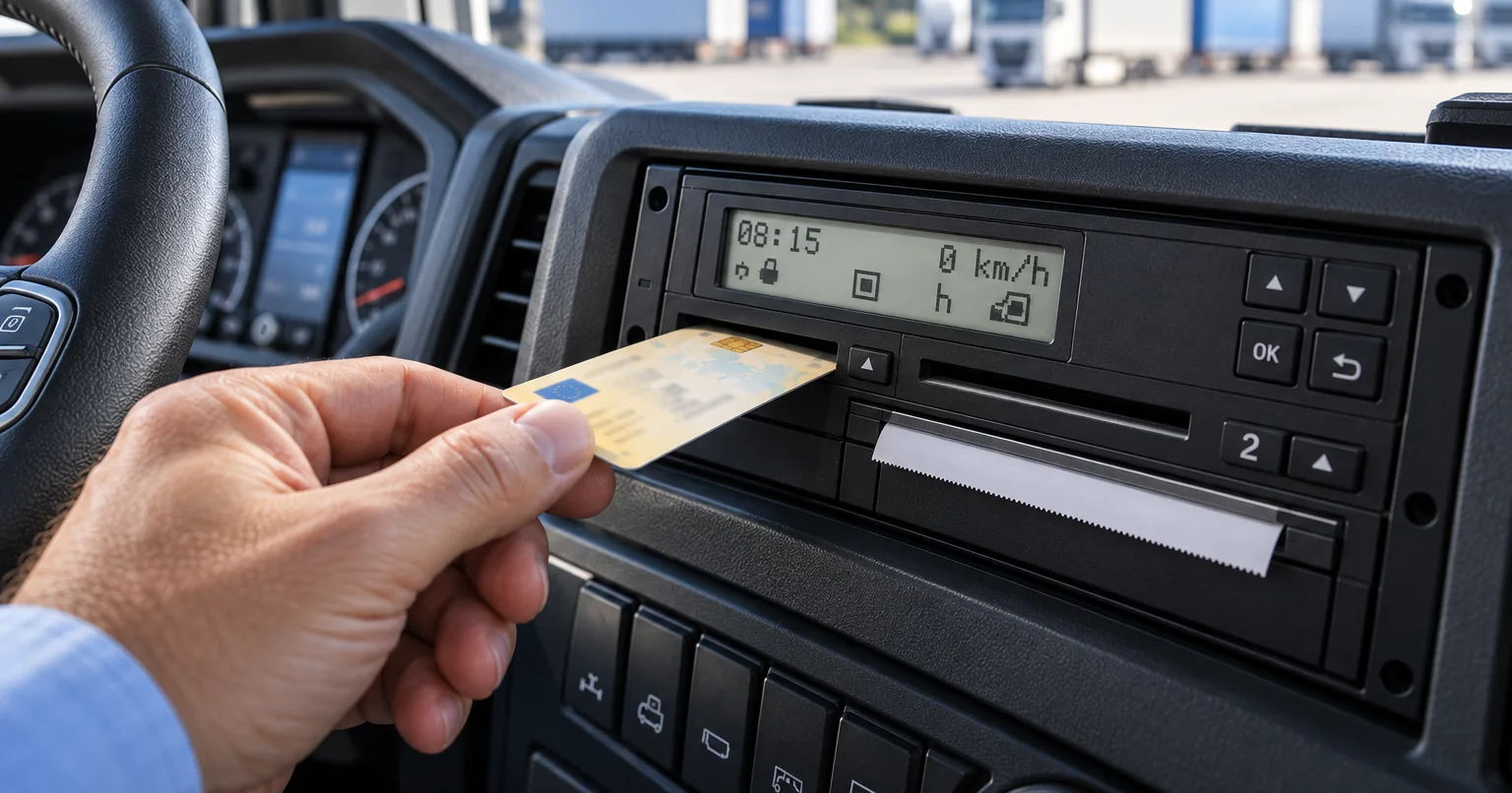
The company card is a chip card for the digital tachograph that identifies the transport operator. It works as a key: it lets you lock the tachograph to your company and display, print and download data from the tachograph of your vehicles. It does not store data about drivers' journeys or activities – it only records its own use, such as company locks and downloads.
The card is not tied to a specific vehicle. One card serves every vehicle with a digital tachograph that you operate. Do not confuse it with the driver card (personal, in the driver's name), the workshop card (for authorised workshops) or the control card (for enforcement officers).
A company profile on search engines or maps has nothing to do with tachographs. This guide covers only the chip card for the digital tachograph under Regulation (EU) No 165/2014.
Who needs a company card
Every operator whose vehicles fall under the tachograph rules needs a company card – without it you cannot lock the tachograph or download data from it.
From 1 July 2026 the circle of operators is wider. Tachographs, and therefore company cards, are now also required for vehicles and vehicle combinations with a maximum permissible mass over 2.5 t used for international carriage of goods or cabotage. What counts is how the vehicle is used – exemptions apply, for example, to some own-account transport. The new rule does not extend tachograph requirements to purely domestic goods transport by vehicles over 2.5 t and up to 3.5 t. Vehicles above 3.5 t are, in principle, already subject to tachograph rules in domestic transport too, unless an exemption applies. Details and exemptions are in our article on tachographs for vans.
Many new operators apply for the card because of roadside checks and think the job is done. The card brings further duties: lock the tachograph, download data regularly, archive it and evaluate whether drivers comply with driving times and rest periods. All of it is explained step by step below.
How to apply for a company card
The procedure is set by each EU country, but the core steps are the same everywhere:
- Apply in the country where your company is established – to the card issuing authority there.
- The application is made by the company – its owner, statutory representative or an authorised person with a power of attorney.
- Prepare company details and ID – company registration details and the identity document of the person applying.
- Pay the fee and wait for delivery – from about one week to one month, depending on the country.
Who issues company cards – overview by country
| Country | Issued by | How to apply | Fee | Official page |
|---|---|---|---|---|
| Great Britain | DVLA | Online | £32 (renewal £19) | gov.uk |
| Ireland | Road Safety Authority (RSA) | Online, or by post | €45 online, €60 by post (per card) | rsa.ie |
| Malta | Transport Malta | Paper form DRV 036 | Not published online – ask Transport Malta | transport.gov.mt |
| Germany | Issuing office of the federal state (e.g. LABO in Berlin, LAGuS in Mecklenburg-Western Pomerania) | In person or online, depending on the state | Set by each state, e.g. €37 in Berlin (€32 for each additional card), €34 in Mecklenburg-Western Pomerania | verwaltung.bund.de |
| Austria | ÖAMTC or ARBÖ | At an ÖAMTC or ARBÖ office | €85 | usp.gv.at |
| Switzerland | Federal Roads Office (FEDRO / ASTRA) | Online or with a paper form; registered office in Switzerland required | CHF 70 online, CHF 85 on paper | astra.admin.ch |
| France | ChronoServices, on behalf of the French State | Online via the HubProTransport portal | €57.21 excl. VAT (€68.65 incl. VAT) | chronoservices.fr |
| Belgium | Service DIGITACH (ITLB), on behalf of the FPS Mobility and Transport | Online or by post; the company must be registered in the Crossroads Bank for Enterprises (BCE/KBO) | €150 incl. VAT | digitach.be |
| Luxembourg | SNCA (Société Nationale de Circulation Automobile) | Paper form signed by the transport manager | €74 per card | snca.public.lu |
| Netherlands | Kiwa Register, on behalf of the ILT | Online with eHerkenning | €141.57 incl. VAT | kiwaregister.com |
| Italy | Chamber of Commerce (Camera di Commercio) of the company's seat | At the Chamber of Commerce; some also accept applications by PEC | €37 (+ €3.17 for delivery by post) | metrologialegale.unioncamere.it |
| Poland | PWPW S.A. | Online via info-car.pl, or by post | PLN 282.90 gross (PLN 230 net) | info-car.pl |
| Hungary | Government office (kormányhivatal), transport authority | Application by the transport manager | HUF 19,000 | kormanyhivatalok.hu |
| Greece | Transport and communications directorate of the regional unit | At the directorate | €200 (sole trader), €300 (legal entity) | mitos.gov.gr |
| Cyprus | Department of Electrical and Mechanical Services (ΤΗΜΥ) | Paper form, in person at a ΤΗΜΥ district office | €100 | mcw.gov.cy |
| Romania | ARR agency for the county of the company's registered office | In person; issued within 15 days at most | RON 300 | arr.ro |
| Republic of Moldova | ANTA (National Road Transport Agency), Chișinău | In person at ANTA | €76, paid in MDL | anta.gov.md |
| Czech Republic | Municipal office with extended powers (ORP) | In person | CZK 700 | portal.gov.cz |
| Slovakia | Card collection point of the Ministry of Transport | In person | €54 incl. VAT | digitalnytachograf.sk |
Fees checked in October 2026. Always confirm the current fee and procedure with the issuing body before you apply.
Is your company established in another country? Apply to the card issuing authority of that country – the European Commission does not currently publish a list of these authorities.
Validity, renewal and lost cards
- Validity: a company card is valid for a maximum of 5 years.
- Renewal: apply in good time – typically no later than 15 working days before the card expires.
- Lost, stolen or faulty card: report it to the issuing authority without delay and apply for a replacement.
- Changed company details: name or address changes require a new card.
Keep the card where it cannot be bent or overheated – ideally in a protective sleeve – and prevent unauthorised use.
How many company cards you need
One company card is enough for the whole fleet. An operator can hold more, and in practice it pays off:
- Several sites – each site can have its own card, so you do not carry one card around.
- Remote download – the company card stays in the card reader at the office. A second card is handy for work at the vehicles.
- Back-up – if one card fails or is lost, you do not lose access to your data while waiting for a replacement.
Locking the tachograph with the company card
The first step after taking over a vehicle is the company lock. Insert the company card into the tachograph and select the company lock-in in the menu. The exact steps differ slightly by manufacturer – see the tachograph manual. You can also have the lock set during installation or calibration at the workshop if you bring the company card with you.
- What the lock does: other companies cannot download data from the locked period. Enforcement officers and, within their authorisation, workshops still have access.
- Without a lock: data from an unlocked period can be downloaded with any company card.
- When selling or returning a vehicle: download the data first, then unlock the tachograph (company lock-out).
Downloading data: 90 and 28 days
With the company card you hold the key to the data – and the duty to download it regularly. Under Regulation (EU) No 581/2010:
- Vehicle unit (tachograph): at least every 90 days.
- Driver card: at least every 28 days.
- Archiving: keep the data for at least 12 months (Article 33 of Regulation (EU) No 165/2014) and make it available to inspectors on request – directly or remotely from your premises.
To download you need a download device: a portable download key, a download station at the office or remote download without visiting the vehicle. More in our guide on downloading, evaluating and archiving tachograph data.
Downloading is not enough – you must evaluate
This is where most new operators go wrong. Downloading and storing the data meets the archiving duty, but not the duty to check your drivers. Under Article 10 of Regulation (EC) No 561/2006 the operator must organise drivers' work so they can comply with the rules, instruct them properly and check regularly that driving times, breaks and rest periods are respected. In practice, these checks are done by evaluating the downloaded data.
With hundreds of records, manual checks are slow and easy to get wrong. TAGRA reads data from tachographs and driver cards, archives it and flags infringements automatically. It prepares reports for inspections and payroll – and it is fully ready for vans as well. Who exactly must evaluate data is summarised in who must evaluate tachograph data from 2026.
Try TAGRA free
Import your first tachograph and driver card files and see infringements at a glance.
Start free trial →Frequently asked questions
What is a tachograph company card?
A chip card for the digital tachograph that identifies the transport operator. It lets the company lock the tachograph and display, print and download its data. It is not tied to one vehicle and does not store data about drivers' activities – it only records its own use, such as company locks and downloads.
Who must have a company card?
Every operator whose vehicles fall under the tachograph rules. From 1 July 2026 this also includes operators of vehicles and combinations over 2.5 t used for international carriage of goods or cabotage, unless an exemption applies.
Do I need a company card for a van over 2.5 t?
For a van or combination over 2.5 t and up to 3.5 t: yes, from 1 July 2026, if it is used for international carriage of goods or cabotage and no exemption applies (for example for some own-account transport). The vehicle must then have a G2V2 smart tachograph and you need a company card. Vehicles above 3.5 t are, in principle, already subject to tachograph rules in domestic transport too, unless an exemption applies.
Where do I apply for a company card?
To the card issuing authority of the country where your company is established – for example the DVLA in the UK, PWPW in Poland, Kiwa Register in the Netherlands, the Chamber of Commerce in Italy or Chronoservices in France. In Germany the issuing office depends on the federal state. The European Commission publishes the contacts of all national card issuing authorities.
How much does a company card cost?
It depends on the country – for example £32 in the UK, €37 in Italy (+ €3.17 for delivery), €85 in Austria, PLN 282.90 in Poland and €141.57 in the Netherlands. In Germany each issuing office sets its own fee – for example €37 in Berlin and €34 in North Rhine-Westphalia.
How long is a company card valid?
A maximum of 5 years. Apply for renewal in good time – typically no later than 15 working days before the card expires.
Can one company have several company cards?
Yes. One card is enough for the whole fleet, but a company can hold more – for several sites, for remote download where the card stays in the reader at the office, or as a back-up. All cards are issued to the same company.
How do I lock the tachograph with the company card?
Insert the company card into the tachograph and select the company lock-in in the menu. The steps differ slightly by manufacturer, so check the manual. Before selling or returning the vehicle, download the data and unlock the tachograph.
How often must tachograph and driver card data be downloaded?
Data from the vehicle unit at least every 90 days and from the driver card at least every 28 days. Keep the downloaded data for at least 12 months.
Is it enough to download and archive tachograph data?
No. Archiving meets the duty to keep data, not the duty to check drivers. Under Article 10 of Regulation (EC) No 561/2006 the operator must organise drivers' work, instruct drivers and regularly check compliance with driving times, breaks and rest periods – in practice by evaluating the downloaded data. TAGRA makes this easier by flagging infringements automatically.